Several years ago, I began looking for a route through to an MBA via less conventional means. My ambition was to develop into a senior strategy position within the nuclear industry and shortly after graduation I was successful in achieving this position.
At the time I was working an inflexible shift pattern, so I was looking for an MBA which offered the most flexibility. The Cardiff Met Advanced Entry was my end goal, and I worked backwards through stages such as a Level 7 Pearson Extended Diploma in Strategic Management & Leadership to achieve the pre-requisites to apply to Cardiff Met.
The pre-meetings to confirm whether the course was right for me cemented this belief. Even in the early stages, the conversations I had with the fantastic staff helped frame my thinking into topics I could explore for the dissertation element of the course that would benefit both me and my organisation.
I knew the Advanced Entry relied on a solid education from the Extended Diploma which enabled you to focus on what you had learned to put into a project. When framing my dissertation, I recognised it needed to develop my weaknesses into strengths, deliver an organisational benefit and address a challenge my team faced.
I’m proud to say I achieved these objectives I set myself and received a distinction for my dissertation.
The engagement and uptake from my research at work was incredibly well received across the business. My research helped me and my team understand just how important leadership styles are in fostering trust in teams and how all manner of working arrangements, such as shift patterns and professions, can affect this. It has changed how I consider and make decisions and our self-awareness as a leadership team.
I have begun implementing the recommendations through our training capability and have been making recommendations to help other students begin post graduate research.
Achieving my ambition
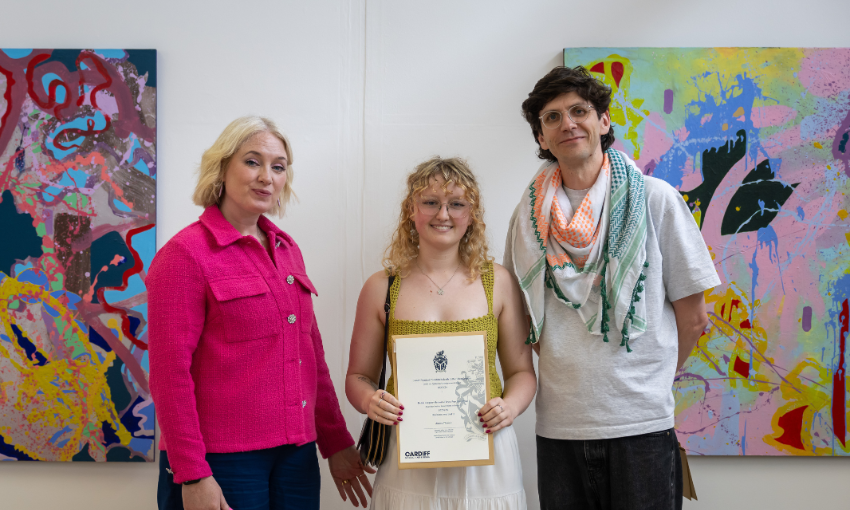
Shortly after graduating, the MBA Advanced Entry has already advanced my career from a Programme Leader at Sellafield Ltd to a Strategy Manager role in the Nuclear Decommissioning Authority, fulfilling the vision and ambition I had from the start of this process. I start this role in September and give thanks to the team at Cardiff Metropolitan University for helping me realise this success!
Three key insights
The three main things I learned on the MBA course were:
- Pushing myself out of my comfort zone was paramount. I wanted to overcome my fear of quantitative and statistical methods. The staff at Cardiff Met really helped me overcome this fear by providing coaching and support, as well as software training to help develop and analyse your data. I now have a much better understanding of application statistical methods.
- Social science research in the nuclear industry is quite rare! I learned a lot even through discarded research that wasn’t applicable to my dissertation but still useful in my career. My dissertation focused on how leadership styles affect trust in organisations. It was a lightbulb moment when I recognised cultural similarities across other sectors of the industry in the literature.
- A solid understanding of Research Methods thanks to the incremental assignment process of the MBA Advanced Entry. The course process distils your thinking and ideas and refines through the assignments into an idea that can be taken forward as a research question. Initially it felt like a huge undertaking just to develop the research question, but I learned how to synergise and rationalise during the literature review to combine ideas and test against academic models.
Five tips for success
The best advice I can give to someone thinking of doing the MBA Advanced Entry, would be to:
- Understand why you’re doing it and how it aligns with your goals – An MBA looks great after your name but how will you use it? I recognised an MBA offered a wider lens than an MSc and it also aligned to my career goals in strategic business management which differs to a typically science and engineering-based industry.
- Set personal non-negotiable goals – Motivation declines with time. Discipline keeps you moving forward. Set yourself small manageable objectives such as “4 hours of research twice a week” or a writing day and a reviewing day with enough time in between to switch off.
- Visualise success – buy your suit, pick your outfit, choose your graduation dinner. Understand the journey isn’t linear and the setbacks are part of growing.
- Find a topic or problem that interests your team – you will then become the expert everyone wants to know, and it will significantly help the engagement you need in your research.
- Enjoy the journey –The uniqueness of the challenges you will face gives an outcome you can share with pride and experience that no one else has!