
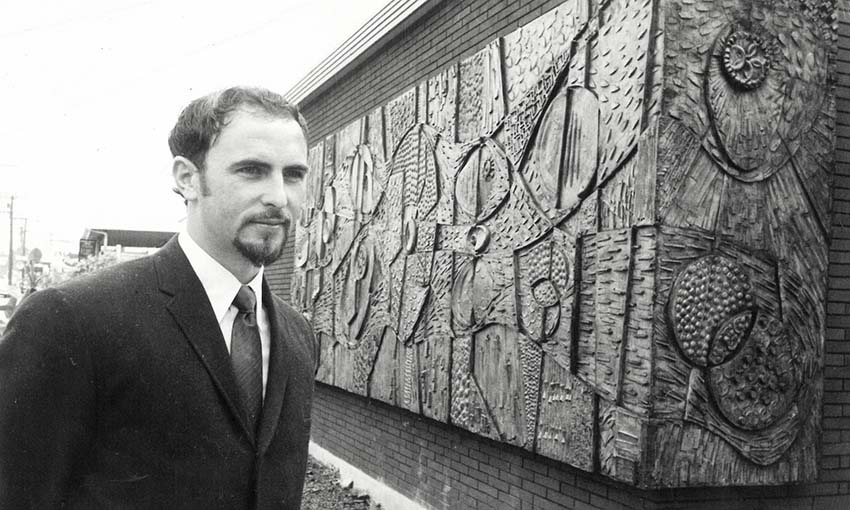
This story is of the parallel life histories of two Cardiff Met university alumni; Peter Colwill and Clive Williams, written by Peter.
After being awarded the Glamorgan Art Scholarship at Mountain Ash Grammar School I studied at Cardiff College of Art. This led to the National Diploma in Art and Design (NDD) where I specialised in painting and secondarily ceramics. I achieved this qualification in 1959 and then followed a course applying my artistic expertise and knowledge to the teaching of art. At the end of this period in 1960 I was awarded an A.T.D.
Clive followed a similar period of study where he achieved an N.D.D. specialising in 3D and sculptures. He likewise attained A.T.D. in 1960. Clive then took up a teaching post in a school in Essex however I am unable to give facts and history of his time there. Despite the story title, the emphasis is on my friendship, association and memories of Clive Williams and his family. I was especially privileged to regard Clive as my best friend, I was best man at his wedding and he at mine.

The Story of Clive Rodrick Williams
Clive was born in Treorchy in the Rhondda. He was one of five; four boys and one girl. Clive’s father, Ivor John Williams was an under manager in the local Park and Dare Colliery. He was a member of the Welsh Choir and as with Clive’s mother, Alined they were members of the Treorchy Choral society. Clive’s brothers, Derek, Brian and Lyn also worked in the Park and Dare Colliery whilst Meryl, Clive’s sister, became a nurse. She worked for a long time in Yellow Knife in the North-western Territories in Canada.
Clive was multi-talented. He had a particular interest in music, specialising in the guitar and he played in a group in the Red Cow public house in Treorchy. He was also a competent motor mechanic and had a special interest in vintage cars, one of which was a Morgan he owned which ended up in a car museum in Swansea. Another car that Clive owned was an Austin 7, in which he drove me to my wedding. Clive was also a joint owner of a small sailing/fishing boat in Pembrokeshire. Not least of his skills was his talent as an Artist. My earliest memories of Clive’s artistic work were from where he had a studio on the top floor of the Parc and Dare Theatre building where his work was confined to painting and drawing.
On returning from an initial teaching post in Dagenham, Clive took up teaching at the Treorchy Comprehensive School. He had already done his teaching practice in the Treorchy Secondary modern school whilst on his A.T.D. year.
Clive was to continue to teach in the Treorchy Comprehensive School until his emigration to Whangarei, New Zealand in 1967, in which he went with his wife Neen and 6-month-old son Rhys. However, of all the many special sculptural pieces that Clive created and produced, I have only been able to depict a small number which relate to this period. Amongst these are two maquettes that Clive gave to me and two other pieces, one of which is an icon and signalled how special Clive was to become. This was a life size picador on horseback built and situated in Clive’s terraced house back garden.
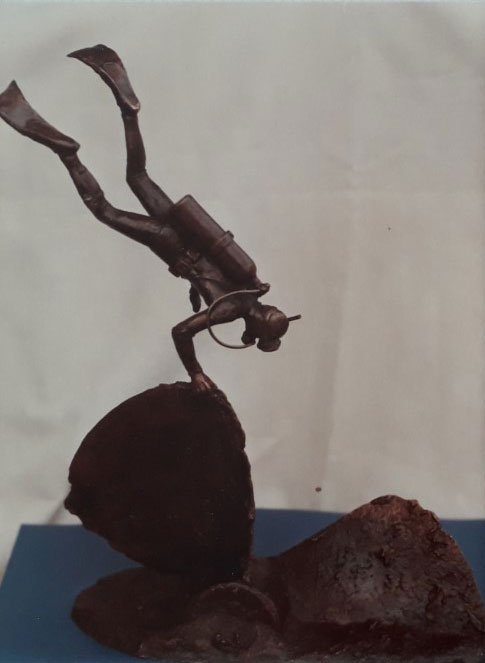
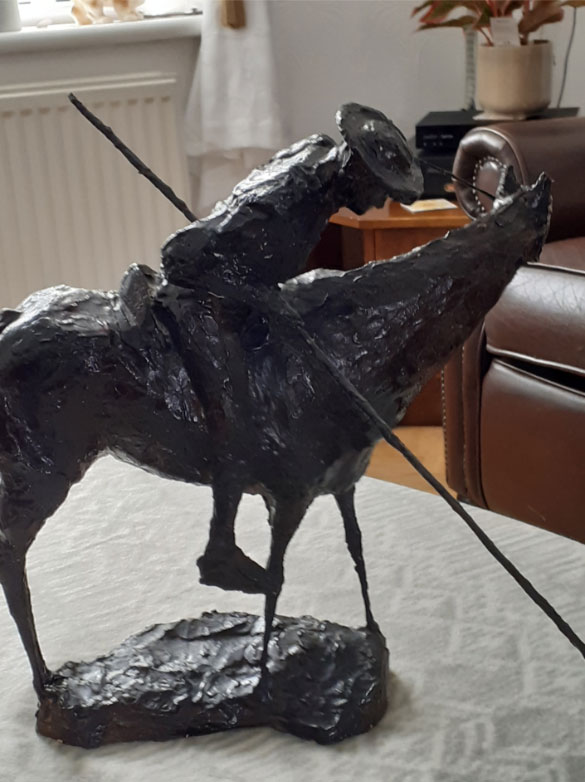
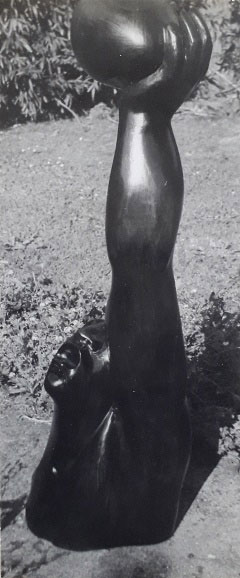
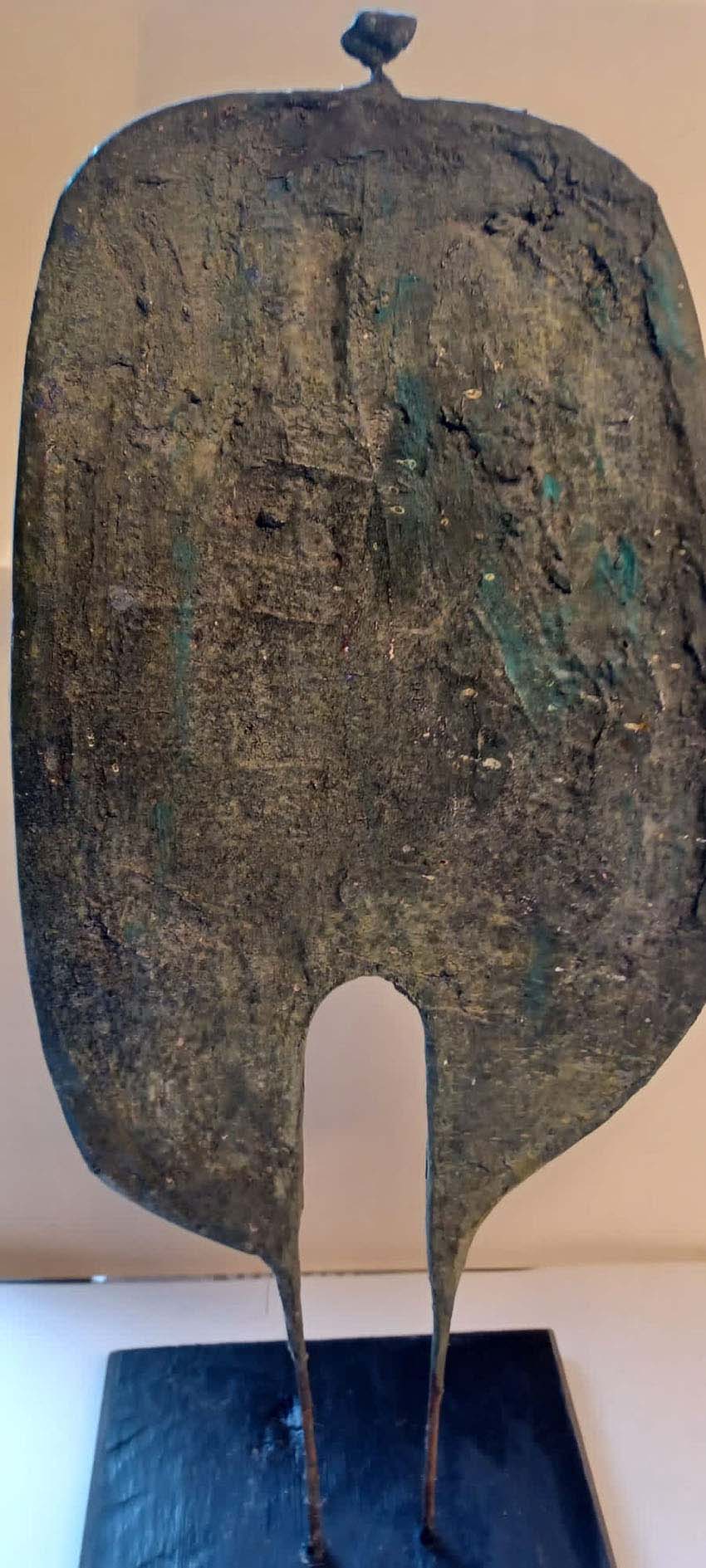
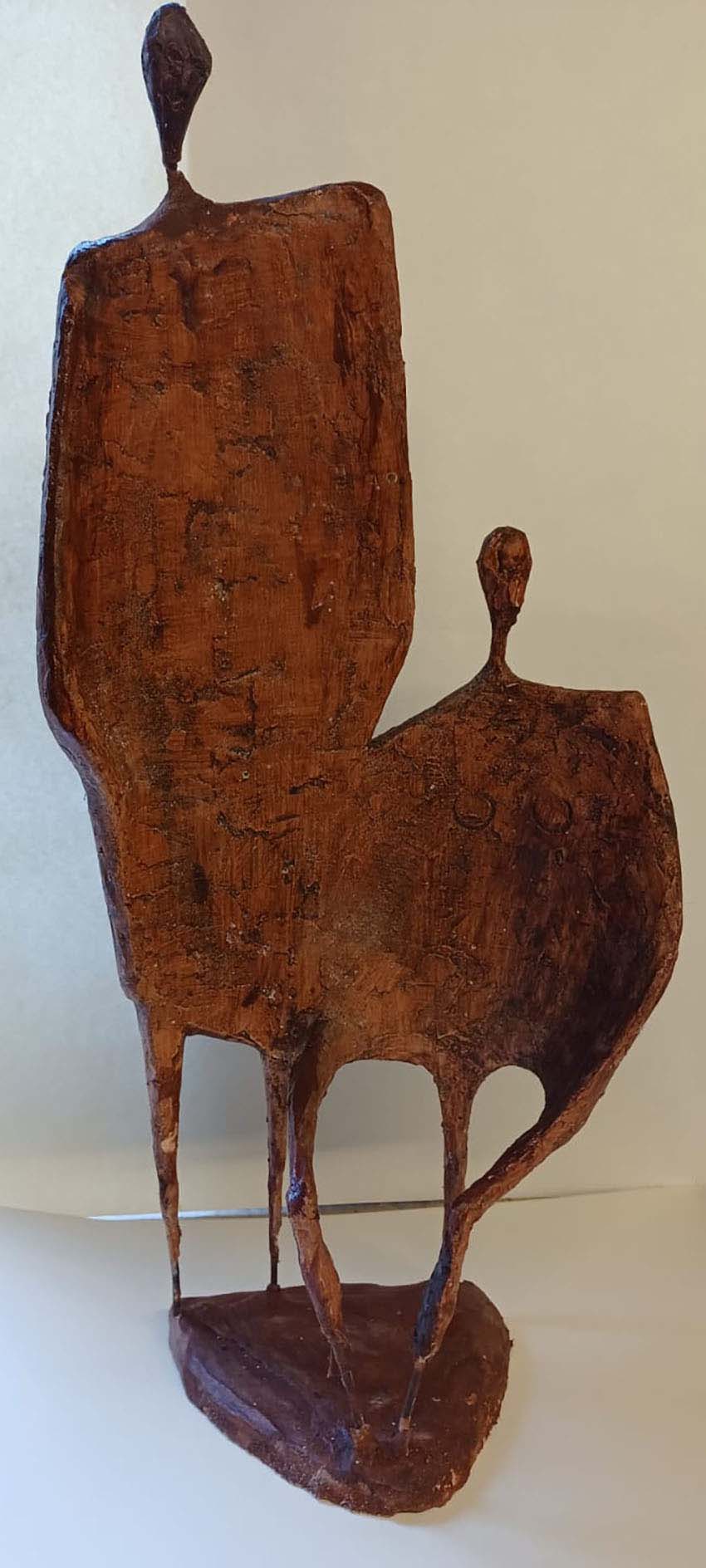
As Neen confirms, in every house that they lived it was essential that Clive had a studio. It was also confirmed that Clive from then on concentrated solely on sculpture. He firstly applied himself to a project based upon rugby players – the All Blacks. This was based upon carvings using Macrocarpa, an evergreen tree that was used essentially for hedging or wind breaks. The sculptures featured heads and arms holding rugby balls and are presented in a black shiny finish. Coupled with their pieces was a full-sized nude female which now resides in a luxury home of the owner of the Hills Golf Course in Queenstown.
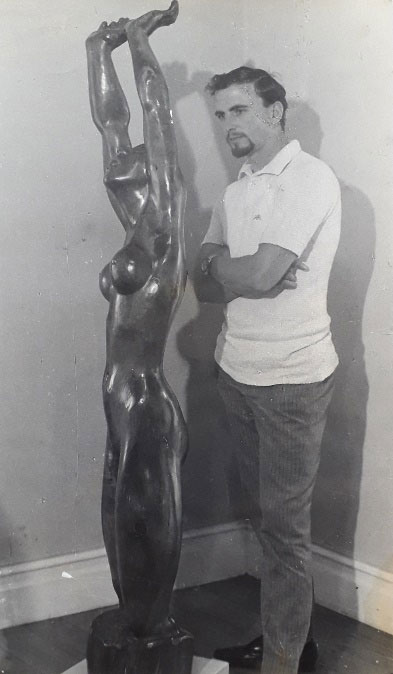
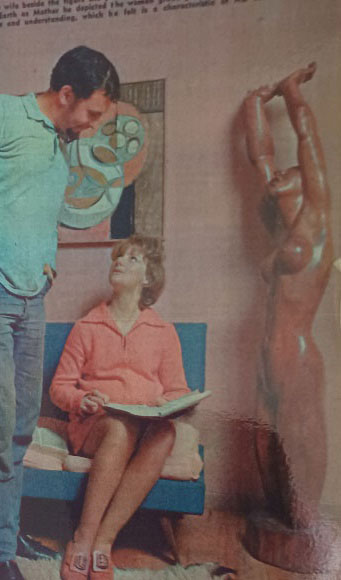

Clive’s next project involved a completely different sculptural medium; ferro cement, and the production of a series of larger-than-life figures.
In respect of this, Clive had a friend who owned a cement works in central Whangarei who let Clive use his facilities. Clive was also to return to Britain and visit a number of cement works in order to seek further expertise of this medium. An outstanding work using this cement medium and reflecting Clive’s techniques was the Life Mural. This involved a combination of 7 panels; 6 metres long and 2.5 metres high and was for a private commission. It is now displayed in a building in a large glass case. The cement murals were based on and made from his clay models.
On a par with this were the many wall panels that Clive did for the District Council, and although using a different medium, a series of major timber wall panels for the Oil Refinery.
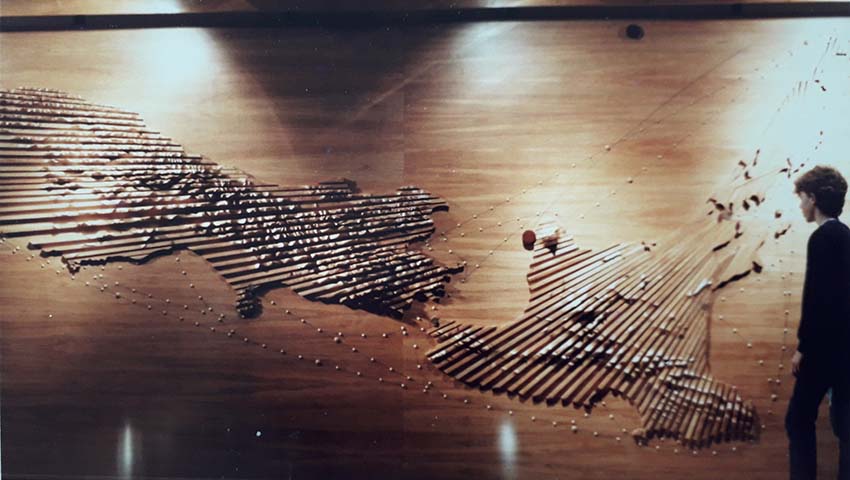
Snorkelling was another of Clive’s numerous talents and, inspired by a family holiday in the islands where he snorkelled, Clive did a series of bronze sculptures. In the words of Neen they “sold like hotcakes”.
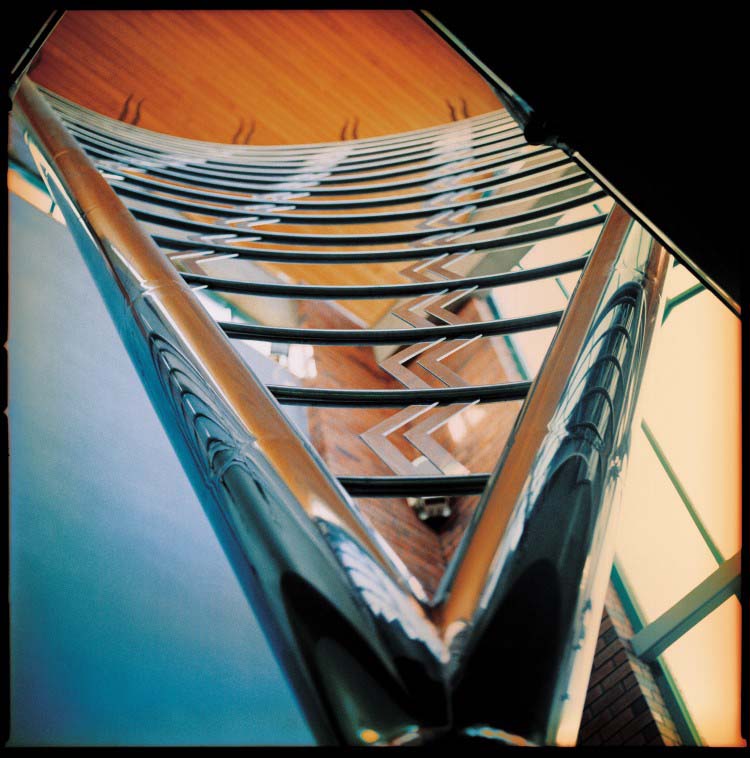
This brings me to the sad point of having to relate how unfortunately Clive’s premature death was to bring the end to such a highly talented creative life history. However, prior to this, Clive together with other Northland artists had submitted their designs and ideas for a sculpture for the Whangarei Courthouse stairwell. Clive’s creation was based upon his vision of building a Māori voyaging canoe, a union of cultures from ancestral voyagers from Hawaiki and to immigrants from Britain and Europe. The achievement of a fairer tomorrow. Clive’s idea was 1 of 3 shortlisted but Clive died before the decision was made.
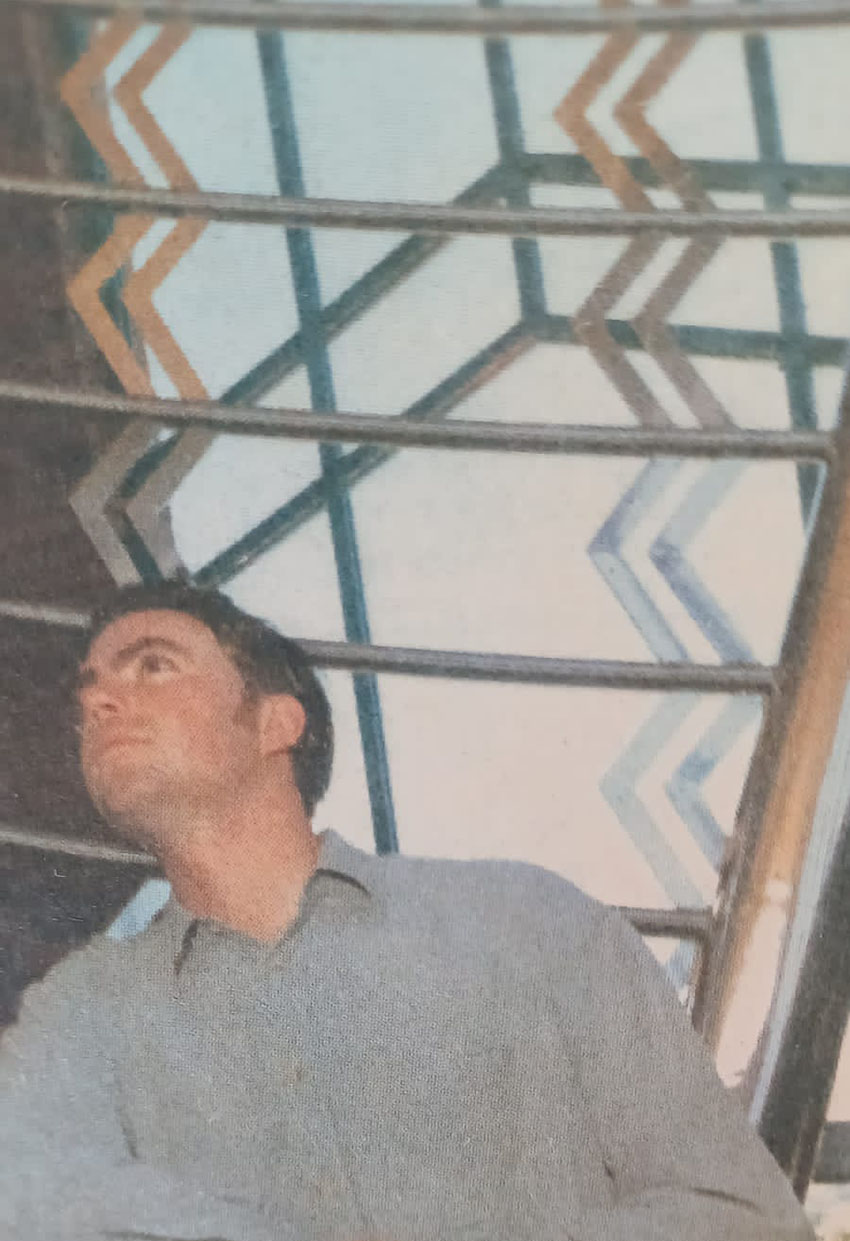
However, a few months later, Grant, Clive’s son, a graduate of Elam Art School in Auckland was contacted by the Courthouse asking if Grant would develop and complete his father’s sculpture. Grant agreed believing it was meant to be and designed the sail as a memorial to his father. The sculpture was 10 metres high and was made of stainless steel, the construction took 9 months.
Clive’s funeral was in two parts. The first was based upon Maori tradition where Clive’s body lay in a ceremonial lodge for 3 days, guarded and watched over. During the service, Clive was given Chief’s recognition by several women singing traditional Maori calls to welcome the body into the building. Neen describes this as “spine chilling”. Clive as a person, his relationships and achievements were so widely recognised that around 700 people attended this service. At this time people were expected to sing and tell stories. The second funeral service was private and for family and close friends.
The District Council sculpture was taken down four years ago to be re-sited and repainted. However Neen’s instance to have it placed again in a public place has paid off and it is to be re-sited in a new park in Central Whangeri a few metres from where Grant’s new sculpture will be situated. It is significant and satisfying to know that Grant is to keep the Williams’ creativity going having already established himself with quite a number of his kinetic sculptures being placed across New Zealand. (Grant’s sculptures can be viewed online under – Grant Williams Sculpture).


Peter, thank you for this offering about Clive’s life and accomplishments. I was a close family friend and his death was a devastation for so many. I was only 17 years old then but I knew he wasn’t only a talented artist and genuine and charming man, but also a rather exemplary human. I think he will always be missed and appreciated. Thank you.
Comments are closed.